Version 0.1
Overview of the input/output requirements for VECTOR. Initially, there will be a single POST endpoint for the frontend to submit parameters to. The backend will then parse the payload and run VECTOR with the proper input files to get a return. The return from the VECTOR code will then be put in the response payload to send back to the frontend.
objectType: string
cylinder, sphere, plate, plate model
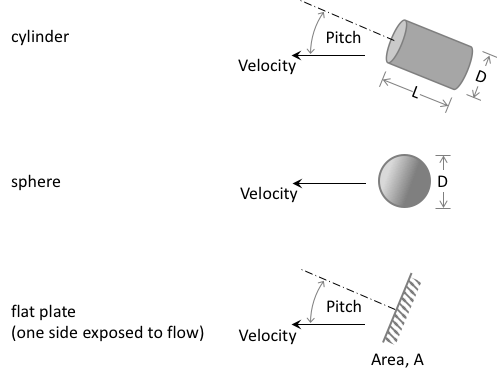
diameter: float
The diameter of the object [m]
length: float
The length of the object [m]
area: float
The area of the object [m^2]
pitch: float
Pitch angle of the object [deg]
sideslip: float
Sideslip angle of the object [deg]
temperature: float
Ambient temperature of the atmosphere [K]
speed: float
Speed of the object [m/s]
composition: dictionary
Number density composition of atmospheric constituents [/m3]


O: float

O2: float

N2: float

He: float

H: float
accommodationModel: string
SESAM, Goodman, Fixed
surfaceMass: float
Surface mass of the object [amu]
energyAccomodation: float
Energy accomodation value for the object [-]
{
"objectType": "cylinder",
"diameter": 1.25,
"length": 2.5,
"area": 0,
"pitch": 30,
"sideslip": 0,
"temperature": 800,
"speed": 7750,
"composition": {"O": 1e11,
                "O2": 1e6,
                "N2": 1e6,
                "He": 1e6,
                "H": 1e4},
"accommodationModel": "SESAM",
"energyAccomodation": 0,
"surfaceMass": 0}
}dragCoefficient: float
The coefficient of drag of the object [-]
projectedArea: float
The projected area of the object [m2]
forceCoefficent: float
The force coefficient of the object [m2]
{
"dragCoefficient": 2.8,
"projectedArea": 3,
"forceCoefficient": 1.2,
"energyAccommodation": 0.930
}